For global buyers, selecting the right Blank Carbide Plate supplier requires more than comparing prices. A dependable partner should understand carbide grades, material composition, surface condition, and dimensional tolerances. These details directly affect tool life, wear resistance, machining accuracy, and production stability. This guide introduces leading supplier qualities for international purchasing decisions. It considers technical capability, manufacturing experience, export performance, and customer support.
Experienced suppliers usually provide complete product data, including cobalt content, grain size, hardness, density, and recommended applications. Buyers should also review inspection procedures, batch consistency, and available custom dimensions. A clear material certificate can make a significant difference during quality verification. So can a responsive engineering team. Suppliers with modern grinding equipment may offer tighter tolerances and cleaner edges. However, advanced equipment alone does not prove consistent performance. Production records and customer references matter.
International orders add practical concerns. Packaging must protect plates from chipping, moisture, and accidental impact during transport. Reliable suppliers should explain lead times, minimum quantities, payment terms, and shipping documents clearly. ISO certification may support credibility, but it should not replace independent evaluation. Some suppliers appear competitive until testing, rework, or delayed delivery increases the total cost. That risk deserves attention. No supplier fits every application, and even a well-established manufacturer may have limitations. Buyers should request samples, verify test results, and compare communication quality before placing large orders. This approach is not perfect, but it creates a more realistic basis for choosing a Blank Carbide Plate supplier.
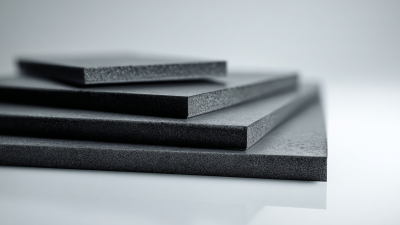
Blank carbide plates are flat, unfinished pieces made from cemented carbide, usually tungsten carbide bonded with cobalt. They are pressed, sintered, and supplied with extra material for later machining. The word “blank” matters. These plates are not always ready for installation.
Their hardness gives them strong resistance to abrasion, heat, and repeated contact. Manufacturers use them for cutting tools, wear strips, forming dies, guide components, and industrial scraper parts. A plate can face abrasive powder, sliding metal, or high-impact service. Its performance depends on more than hardness. Grain size, cobalt content, thickness tolerance, and edge design also affect service life.
A practical purchasing check should include grade data, density, hardness, transverse rupture strength, and dimensional tolerances. Ask whether the surface is ground, lapped, or left as-sintered. Small differences can change fitting accuracy. The term “high quality” is too vague without inspection records. Buyers should compare samples under the same working conditions, not only compare prices.
Blank carbide plates are often selected for their machining allowance. Grinding or wire cutting can create the final profile. However, carbide is hard and brittle, so careless clamping may cause edge chipping. This point is easy to underestimate. Even a well-made plate can fail when the wrong grade meets shock loading. Application details, including temperature, contact pressure, abrasive type, and expected replacement time, should guide the specification.
Choosing a carbide plate supplier requires more than comparing prices. Buyers should verify carbide grade, cobalt content, grain size, dimensions, and intended application. These details affect wear resistance, toughness, and machining performance. Ask for recent material test reports, not generic certificates. The report should match the supplied batch.
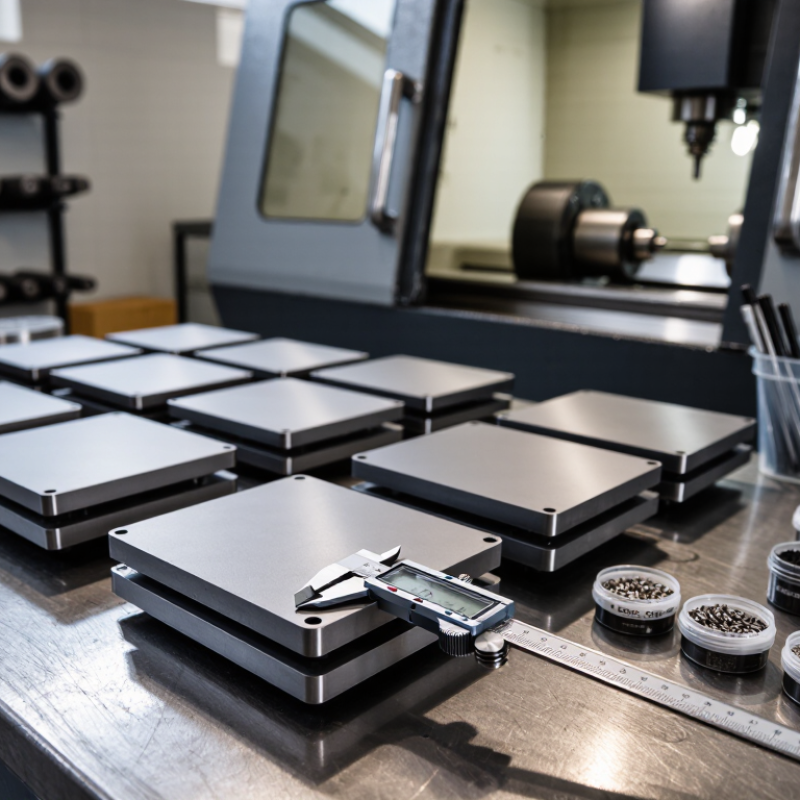
Production control matters. Check whether the supplier manages pressing, sintering, grinding, and final inspection internally. Request evidence of thickness tolerance, flatness, surface roughness, and edge quality. A practical sample can reveal more than polished photographs. Measure it with calibrated tools. Record the results.
Traceability is equally important. Each batch should have a clear lot number, inspection record, and packing reference. Export experience also deserves attention. Confirm lead times, moisture-resistant packaging, labeling, and documentation before placing a large order. Communication should be precise, especially when drawings use different unit systems.
A low quotation can be misleading. It may exclude grinding, testing, or protective packaging. This happens more often than buyers expect. During supplier reviews, ask how rejected plates are handled and how process problems are corrected. A reliable supplier should discuss weaknesses openly, although not every answer will sound perfect. Flexible payment terms are useful, but consistent quality and responsive technical support usually protect the project better. Start with a controlled trial order, then compare performance against the approved sample.
China remains a major sourcing region for blank carbide plates, supported by large powder-processing and sintering networks. Suppliers there often offer broad grade ranges, custom dimensions, and competitive production volumes. European producers usually focus on tight tolerances, documented process control, and demanding industrial applications. Japan and South Korea are known for consistent material preparation and disciplined quality inspection. North American suppliers often combine local inventory with technical support and machining services.
Supplier type matters as much as location. Integrated manufacturers control powder mixing, pressing, sintering, grinding, and inspection under one system. This can improve traceability. Specialized carbide plate producers may provide deeper knowledge of grain size, cobalt content, and edge preparation. Distributors are useful when buyers need small batches, rapid delivery, or multiple grades from one warehouse. However, their technical control may be limited. Samples reveal gaps.
A reliable evaluation should include mill certificates, dimensional reports, density data, and batch identification. Ask whether the stated hardness was tested under a recognized method. Check flatness with calibrated equipment, not visual judgment. For a 100 mm plate, even a small thickness variation can affect downstream grinding. Packaging also deserves attention; moisture barriers and rigid supports reduce transit damage. I have found that polished documentation sometimes hides weak communication. Response speed, corrective-action records, and sample consistency deserve equal weight. Fit matters more.
When comparing blank carbide plate suppliers, start with measurable quality, not polished catalog photos. Ask for tungsten carbide grade, cobalt percentage, grain size, density, hardness, transverse rupture strength, and flatness data. One mistake is treating HRA as the whole truth. A harder plate may still chip under impact. Request recent inspection reports, dimensional records, and a sample from the same production route. The USGS Mineral Commodity Summaries 2024 estimated global tungsten mine production at about 78,000 metric tons in 2023, with China supplying roughly 63,000 tons. This concentration makes traceability and supply continuity important.
Pricing needs a landed-cost comparison. Include machining allowance, thickness tolerance, minimum order quantity, packaging, freight, duties, and replacement risk. A cheaper plate can become expensive after grinding or rejected batches. Check whether the quotation uses EXW, FOB, or DDP terms. Certifications should match the purchase risk. The ISO Survey 2022 recorded more than 1.26 million ISO 9001 certificates worldwide, but a certificate alone does not prove carbide performance. Verify its scope, issuing body, validity, and connection to the actual factory. For environmental or export requirements, request applicable ISO 14001, RoHS, REACH, and material declarations. Delivery promises also need evidence: production lead time, monthly capacity, inspection time, and available safety stock. Ask for a realistic schedule, not the best-case answer. Supplier evaluation is rarely perfect. Keep testing small batches before committing to repeated global shipments.
| Anonymous Supplier Profile | Typical Supply Region | Common Carbide Grades | Cobalt Content | Typical Grain Size | Hardness Range | Transverse Rupture Strength | Dimensional Tolerance | Quality Documentation | Certification Indicators | Indicative Price Range | Typical MOQ | Standard Production Lead Time | Export Packaging | Best Fit for Buyers |
|---|---|---|---|---|---|---|---|---|---|---|---|---|---|---|
| Profile A High-Volume Manufacturer |
Asia-based production with worldwide export capability | General-purpose grades equivalent to ISO K10-K20 and K30-K40 | 6%–15% cobalt | 0.5–2.0 μm | 88.0–92.5 HRA | 1,800–2,500 MPa | Typically ±0.05 mm for standard dimensions; tighter tolerance available by request | Mill certificate, lot traceability, hardness report, dimensional inspection report | ISO 9001 commonly available Inspection records should be verified per order |
US$40–90/kg for standard blanks; custom sizes may be higher | 50–100 kg or one standard production lot | 20–35 days after drawing and payment confirmation | VCI or moisture-resistant inner packaging, export carton, palletized shipment | Large-volume cutting-tool, wear-part, and industrial-component programs |
| Profile B Precision Plate Specialist |
East and Southeast Asia with strong custom-machining support | Fine-grain grades for wear plates, precision inserts, and profile blanks | 6%–12% cobalt | 0.2–0.8 μm | 90.0–93.5 HRA | 1,500–2,200 MPa | Typically ±0.02 mm after grinding; flatness often controlled to 0.03 mm per 100 mm | Material certificate, batch number, grinding inspection report, surface-finish data | ISO 9001 or equivalent QMS Request third-party inspection for critical orders |
US$70–150/kg depending on grade, thickness, grinding, and quantity | 10–30 kg for standard sizes; custom tooling may require a higher minimum | 25–45 days, including precision grinding | Anti-impact separators, corrosion-resistant wrapping, rigid wooden or reinforced cartons | Buyers requiring tight tolerances, low surface variation, and repeatable batches |
| Profile C Custom-Engineering Supplier |
Europe and North America-oriented technical supply network | Application-specific grades selected for impact, abrasion, or corrosion resistance | 6%–20% cobalt | 0.5–3.0 μm | 86.0–92.0 HRA | 1,600–3,000 MPa | Drawing-controlled; approximately ±0.01–0.05 mm depending on size and finishing process | Full material traceability, inspection plan, certificate of conformity, nonconformance procedure | ISO 9001 frequently requested ISO 14001 and customer-specific audits may apply |
US$90–220/kg for engineered or low-volume parts | 5–20 kg or a negotiated prototype quantity | 30–60 days for new tooling, prototypes, or complex geometries | Custom foam protection, humidity control, shock-resistant cases, serialized labels | Engineering trials, mining wear parts, and products requiring technical consultation |
| Profile D Distributor and Stocking Supplier |
Regional warehouses serving North America, Europe, and the Middle East | Standard ISO K10-K40, M10-M30, and selected P-grade carbide blanks | 6%–15% cobalt | 0.5–2.5 μm | 87.5–92.0 HRA | 1,700–2,600 MPa | Usually standard commercial tolerance; precision grinding may be subcontracted | Supplier mill certificate, batch identification, incoming inspection record | Certification varies by source mill Verify the original manufacturer and certificate validity |
US$65–180/kg, generally higher for small quantities and stocked items | 1–10 kg for available stock; custom orders follow source-mill MOQ | 3–15 business days for stock; 25–50 days for replenishment | Warehouse-grade protective packaging with lot labels and shipment documentation | Urgent replacement orders, sampling, maintenance, and low-volume procurement |
| Profile E Cost-Focused Standard Supplier |
Asia-based export supplier focused on standard dimensions | Conventional medium- and coarse-grain grades for general wear applications | 10%–20% cobalt | 1.5–5.0 μm | 84.0–89.5 HRA | 2,000–3,200 MPa | Typically ±0.08–0.15 mm before optional grinding | Basic certificate of conformity, batch label, hardness data when requested | Confirm QMS and testing scope before purchase | US$30–70/kg for standard blanks and larger quantities | 100–300 kg or a full standard batch | 18–30 days for standard products; longer for custom sizes | Standard export carton, separators, plastic wrapping, pallet on request | Price-sensitive wear applications where extreme precision is not required |
| Profile F Premium Quality-Control Supplier |
Global supply with stringent inspection and aerospace or energy-sector processes | Ultra-fine, submicron, and application-specific cemented carbide grades | 3%–15% cobalt | 0.1–0.8 μm | 90.0–94.5 HRA | 1,200–2,400 MPa | Approximately ±0.01–0.03 mm after precision grinding, subject to geometry | Complete traceability, inspection plan, statistical process data, certificate of conformity, test reports | ISO 9001; ISO 14001 or sector-specific systems may be available | US$120–300/kg, depending on grade, inspection, and finishing requirements | 5–25 kg, with prototype quantities negotiated case by case | 35–70 days for qualified or highly customized products | Clean-room-style handling where required, sealed moisture barrier, impact protection, detailed labeling | Critical tooling, high-wear applications, and buyers prioritizing traceability over lowest price |

Buyer note: Price, MOQ, hardness, strength, tolerance, certification availability, and delivery time are indicative market benchmarks rather than quotations. Confirm the exact grade, tungsten-carbide grain size, cobalt percentage, test method, inspection standard, Incoterm, packaging requirements, and certificate scope before placing an order. Common verification references include ISO 3878 for hardness, ISO 3327 for transverse rupture strength, EN 10204 for inspection documents, and ISO 9001 for quality-management systems.
Selecting a reliable international blank carbide plate supplier requires more than comparing unit prices. USGS Mineral Commodity Summaries 2025 classifies tungsten as a critical mineral and identifies China as the dominant producer. This concentration makes supply transparency important. Ask where tungsten powder, cobalt binder, and finished plates originate. Request lot-level certificates showing density, hardness, grain size, and transverse rupture strength. A certificate without traceable lot numbers is weak evidence.
Inspect a pre-production sample before approving volume orders. Measure thickness at several points, check edge chipping under good lighting, and compare the report with laboratory results. ISO 9001 certification helps, but it does not guarantee consistent carbide quality. Audit records, calibration dates, nonconformity reports, and corrective-action responses. The supplier should explain these details clearly, not hide behind polished documents.
Logistics deserves equal attention. UNCTAD’s Review of Maritime Transport reports that more than 80% of global merchandise trade moves by sea, so port delays can affect production schedules. Confirm Incoterms, export documents, packaging methods, insurance, and realistic lead times. Use sealed moisture-resistant packaging and protective separators for thin plates. Begin with a small trial order and define acceptance criteria in writing. A low quote can become expensive after rework, customs delays, or inconsistent batches. A spreadsheet never tells the whole story. Supplier evaluation is imperfect, and periodic review remains necessary.
Best-practice scorecard for selecting a reliable international supplier
This buyer scorecard uses a practical 100-point evaluation model. Product consistency, dimensional control, documentation, delivery performance, and technical support should be verified with samples, inspection records, certificates, and recent order references before approval.